- Home
- Priorities
- Equity and Engagement
- Cumulative Impacts
- Cumulative Impacts - Monitoring
Cumulative Impacts - Monitoring
We have been measuring the air quality in the Puget Sound region since 1967. Our core monitoring network measures a suite of air pollutants. The instruments we use report the combined total of all sources of that pollutant. Our monitoring sites track compliance with health-based national ambient air quality standards; support burn bans and forecasting; and characterize pollution sources of interest. PM2.5 contributes most of the health risk from air pollution in our region and each of our sites has a PM2.5 monitor. Many sites also measure black carbon (which helps us track difference sources of PM2.5).
Using these monitors, our core monitoring network measures the cumulative amount of all particle pollution sources at each site. Over the decades we have seen particle pollution decrease substantially, but there are still significant sources of pollution, including wood smoke, diesel exhaust, and wildfire smoke.
You can find the latest data from our core network on our Network Map. View and download historical data on our Air Graphing Tool. And learn more about air pollution in our region from our Annual Data Summary.
PurpleAir Sensors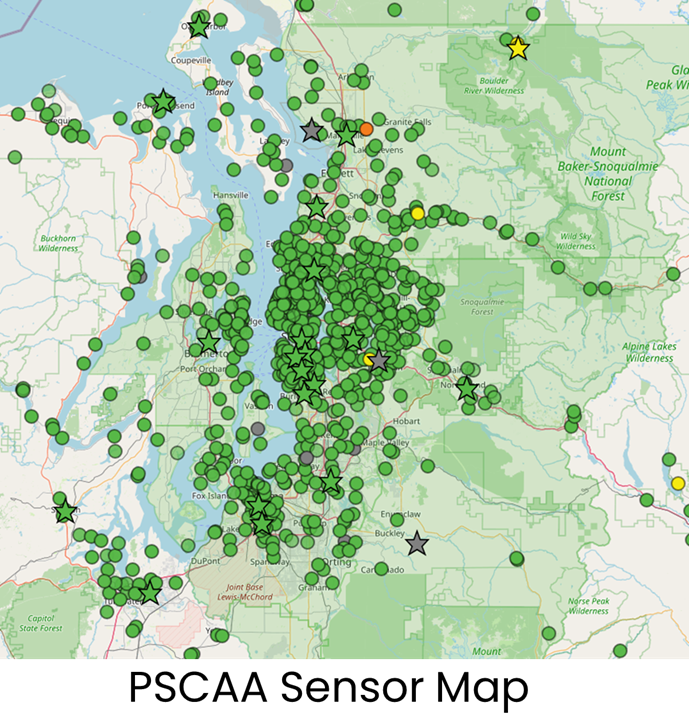
PurpleAir sensors are a network of low-cost air quality monitors that use lasers to count and size airborne particles. They collect real-time data on particulate matter (PM) concentrations and display it on a global map used by community members, researchers, and officials.
When we started working with Purple Air sensors in 2017, there were less than a dozen in our four counties. As of Fall 2024, there are over 850! The density of these sensors allows us to dramatically increase the resolution of our particle pollution data and maps. With the current density, over 90% of our population lives within 3 miles of an air sensor, providing local PM2.5 information to our residents.
You can find real-time particle pollution data on our Sensor Map.
Air Toxics
Air toxics are a group of hundreds of different chemicals which are known or suspected to cause serious health problems above certain thresholds. Potential health effects include cancer, lung damage, heart disease, and nerve damage.1 In our region, the health risk from air toxics comes primarily from fine particles in diesel exhaust, also referred to as diesel particulate matter (DPM).
Our 2023 air toxics study measured the cumulative air toxics impact in our region and estimated that diesel exhaust particles accounted for over 80% of the potential cancer risk. Diesel pollution comes from diesel-fueled trucks, cars, buses, construction equipment, rail, marine, and port activities. In industrial areas, hexavalent chromium, a harmful chemical, posed the next highest potential cancer risk at 5%.